“To speak of things that are important to a Samurai in their order of importance, the first is to commit one’s life unstintingly to one’s lord. As for what one should do over and above that, inwardly, one should fully develop oneself in the virtues of wisdom (chi) fellow feeling (jin) and courage(yu). It appears for an ordinary person to be fully developed in all three virtues is not possible, but actually it is easy. Wisdom is nothing more than to discuss things with others. There is an inexhaustible wisdom in this. Fellow feelings means to act with the view to the benefit of others. One simply needs to compare oneself with others and always choose what will be good for the other person. Courage means to grit one’s teeth. All one needs to do is grit one’s teeth and, without thinking of before and after, charge forward resolutely until the thing is done. I know of no way of holding one’s mind that is better than this.”
It is a difficult thing to despise unrighteousness (fugi) and hold onto rectitude (gi). nevertheless, to think that rectitude is supreme and devote oneself exclusively to that rectitude is actually quiet mistaken. There is a Way above and beyond rectitude. It is a difficult thing to find it, but for those that do, it is the highest wisdom. When one looks from the higher point of view, rectitude is something small. However, even when one is not able to find it on ones own, there is a way to achieve this Way. It is through talking to others. Even a person that has not mastered the Way can see another person’s affairs quite clearly as an uninvolved bystander. It is like the saying in the game of go that ” the bystander sees the best of the game”. To ‘become aware of one’s wrongs in every thought.” is also best achieved through talking with other people. The reason we listen to what they say and read in books is also to learn to discard our own judgements and internalise the judgements of people of former times.
Posted in Uncategorized | Leave a Comment »
Because one takes on all manner of tasks with just one’s small portion of wisdom, everything becomes self-centred, contrary to the Way of Heaven, leading to evil actions. Viewed from the side that sort of wisdom is dirty, weak, narrow-minded and inflexible.When one finds one self at a loss for real wisdom, it is a good idea to discuss the matter with some one else. Because the other person is uninvolved third party and can consider the matter objectively without self-centred bias, the conclusions you reach will accord with the correct way. Viewed for the side, it will seem firmly rooted and reliable. It will be like a great tree which has grown many roots. The wisdom of just one person is like a tree stuck in the ground with no roots.
Posted in Uncategorized | Leave a Comment »
“The samurai who is always in a state of readiness is not simply one who, when he encounters a situation, grasps the situation and knows how to deal with it it skillfully, on the basis of his experience. Rather it is a matter of considering carefully the way one should handle all kinds of situations before they actually occur, so when one does encounter a particular situation, one will be able to carry through the plan of action that one has thought out. Thus the Samurai who has thought everything out and set his heart with determination is what we call a Samurai who is always prepared.”
Posted in Uncategorized | Leave a Comment »
Posted in Uncategorized | Leave a Comment »
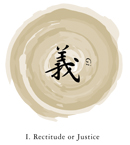
Bushido refers not only to martial rectitude, but to personal rectitude: Rectitude or Justice, is the strongest virtue of Bushido. A well-known samurai defines it this way: ‘Rectitude is one’s power to decide upon a course of conduct in accordance with reason, without wavering; to die when to die is right, to strike when to strike is right.’ Another speaks of it in the following terms: ‘Rectitude is the bone that gives firmness and stature. Without bones the head cannot rest on top of the spine, nor hands move nor feet stand. So without Rectitude neither talent nor learning can make the human frame into a samurai.’ This is about doing the right thing or making the right decision, not because it’s easy, but because it’s ethically and morally correct. No matter the outcome or result, one does not lose face if tempering proper justice.
Posted in Uncategorized | Leave a Comment »
“Fudo myōō is found in Shingon Buddhism as a guardian deity, (and patron of martial arts) who is portrayed as carrying a sword in his right hand (to cut through delusions and ignorance) and a rope in his left (to bind “evil forces” and violent or uncontrolled passions and emotions).
In Aikido, we train in mind and body unification in order to efficiently do different waza. This is the key to be able to move naturally and to be able to practice Aikido in such a way that we do not rely on much strength to effectively do a particular technique. However, to accomplish this, we should remain calm amid the chaos in a martial situation. This is where the principle of Fudoshin comes in.
Fudoshin can be translated as the “immovable mind” or “unshakable heart”.
It is composure under pressure. It is a state of having an unwavering will; a spirit undeterred by the obstacles that lie ahead. It is a state of commitment coupled with fearless determination. And it is with Fudoshin that a person can maintain internal tranquillity in the middle of external conflict. It is a state of mind that remains unmoved by distractions. It is the manifestation of fortitude.
Fudoshin serves as a shield of the heart. In Japan, there is a concept of Shikai: the 4 sicknesses of the mind that a budoka has to avoid at all costs. These are Kyo (surprise), Ku (fear), Gi (doubt), and Waku (confusion):
Kyo (Surprise)
If you are surprised, time stops for you. You will stop moving, you may even find yourself holding your breath while your mind “catches-up” with what is happening around you. In this state of surprise, your concentration is broken. This is a weakness for the martial artist because in that split-second of broken concentration, you have already been defeated.
Ku (Fear)
Fear cripples. It makes the attacker seem bigger and stronger than he really is. If you are afraid of the aggressor, you have already mentally surrendered to him. There is no chance of victory when your mind is already defeated from the very beginning.
Gi (Doubt)
Doubting your expertise is fatal in a martial situation. The way to safeguard yourself against doubt is through incessant training. If you doubt, you are undecided, and your technique becomes half-hearted. You cannot respond to the assault properly when you have this lack of conviction stemming from a mind that doubts. Indecisiveness can be very costly.
Waku (Confusion)
Mental confusion is the opposite of concentration. It stems from a lack of focus, and an admission of inexperience. When you are confused, your movements become unrefined, your timing suffers, and your reaction is stifled. To be confused is to be overwhelmed.
In Aikido, Fudoshin is being in a state that is incorruptible. It is achieving a mind that is clear and determined; and having a spirit that is centred. These sicknesses corrupt concentration. To be able to maximise your potential as an Aikidoka, training yourself to be in this state of Fudoshin is very important. It is with Fudoshin that one can find himself possessing an unperturbed determination to complete a task by having a “courage-filled endurance” of the mind to do what one has set out to do.”
Posted in Uncategorized | Leave a Comment »
What is truth?
Truth is one of the central subjects in philosophy. It is also one of the largest. Truth has been a topic of discussion in its own right for thousands of years. Moreover, a huge variety of issues in philosophy relate to truth, either by relying on theses about truth, or implying theses about truth. It would be impossible to survey all there is to say about truth in any coherent way. Maybe it is easier to go back to bushido principles:
GI –Integrity.
Be acutely honest throughout your dealings with all people. Believe in justice, not from other people, but from yourself. All points of view are deeply considered regarding honesty, justice and integrity. Integrity is a concept of consistency of actions, values, methods, measures, principles, expectations, and outcomes. In ethics, integrity is regarded as the honesty and truthfulness or accuracy of one’s actions. Integrity can be regarded as the opposite of hypocrisy in that it regards internal consistency as a virtue, and suggests that parties holding apparently conflicting values should account for the discrepancy or alter their beliefs. Honesty refers to a facet of moral character and denotes positive, virtuous attributes such as integrity, truthfulness, and straightforwardness along with the absence of lying, cheating, or theft.
‘We tell lies when we are afraid….afraid of what we don’t know, afraid of what others will think, afraid of what will be found out about us. But every time we tell a lie, the thing that we fear grows stronger.’ Tad Williams
Posted in Uncategorized | Leave a Comment »
“Mushin (無心; Japanese mushin; English translation “no mind”) is a mental state into which very highly trained martial artists are said to enter during combat.[1] They also practice this mental state during everyday activities. The term is shortened from mushin no shin (無心の心), a Zen expression meaning the mind without mind and is also referred to as the state of “no-mindness”. That is, a mind not fixed or occupied by thought or emotion and thus open to everything.
Mushin is achieved when a person’s mind is free from thoughts of anger, fear, or ego during combat or everyday life. There is an absence of discursive thought and judgment, so the person is totally free to act and react towards an opponent without hesitation and without disturbance from such thoughts. At this point, a person relies not on what they thinkshould be the next move, but what is their trained natural reaction or what is felt intuitively. It is not a state of relaxed, near-sleepfulness, however. The mind could be said to be working at a very high speed, but with no intention, plan or direction.
Some masters believe that mushin is the state where a person finally understands the uselessness of techniques and becomes truly free to move. In fact, that person will no longer even consider themselves as “fighters” but merely living beings moving through space.
The legendary Zen master Takuan Sōhō said:[2]
The mind must always be in the state of ‘flowing,’ for when it stops anywhere that means the flow is interrupted and it is this interruption that is injurious to the well-being of the mind. In the case of the swordsman, it means death. When the swordsman stands against his opponent, he is not to think of the opponent, nor of himself, nor of his enemy’s sword movements. He just stands there with his sword which, forgetful of all technique, is ready only to follow the dictates of the subconscious. The man has effaced himself as the wielder of the sword. When he strikes, it is not the man but the sword in the hand of the man’s subconscious that strikes.
However, mushin is not just a state of mind that can be achieved during combat. Many martial artists train to achieve this state of mind during kata so that a flawless execution of moves is accomplished — that they may be achieved during combat or at any other time. Once mushin is attained through the practice or study of martial arts (although it can be accomplished through other arts or practices that refine the mind and body), the objective is to then attain this same level of complete awareness in other aspects of the practitioner’s life.”
Posted in Uncategorized | Leave a Comment »
Posted in Uncategorized | Leave a Comment »
 Bigg Elephant