Feeds:
Posts
Comments

Karate World Championships Postponed by Earthquake

May 13, 2016. 12:34 pm.

Duncan Bigg

The Chito-ryu Karate World Championships (Soke Cup) has been postponed as a result of the recent earthquakes in Kumamoto, Japan.
japan

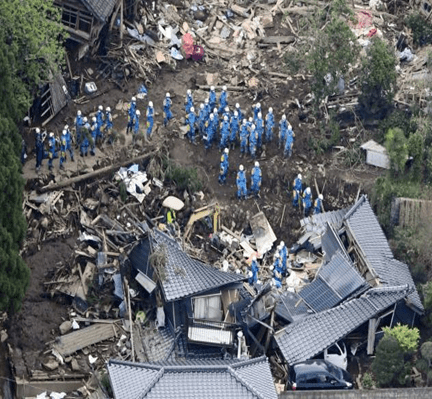
Pictured: The devastation caused by the April, 2016 earthquakes in Japan.

Kumamoto, Japan, is the home or Chito-ryu Karate with it International headquarters (Sohonbu) based there.

The Kumamoto earthquake struck on April 16, beneath Kumamoto city, in the Kyushu Region, Japan. It was preceded by a foreshock earthquake on April 14, 2016.

The earthquakes killed at least 49 people and injured around 3,000 others.

Severe damage occurred in Kumamoto will numerous structures collapsing and catching fire.

More than 44,000 people had been evacuated from their homes due to the disaster, many won’t return until their homes are reconstructed.

The Chito- ryu World champions (Soke Cup) are held every three years in different countries around the world. This year it was to be held in Kumamoto, in mid- August. It is expected that the tournament will be postponed to a time to be determined next year.

A lot of other permanent Karate schools (dojos) in the region have also been damaged, and Japanese competitors have few places to train as many of the community centres are now being used to accommodate the homeless.

There are concerns that the headquarters (Sohonbu) of Chito-ryu Karate, which was damaged in the earthquake, will never be rebuilt.

Sensei Martin Phillips, who operates Sunshine Coast Karate, said “the news was devastating, and very sad for the Chito-ryu community as a whole, with many International students having visited and trained at the home of Chito-ryu karate in Kumamoto.”
DSC_0109

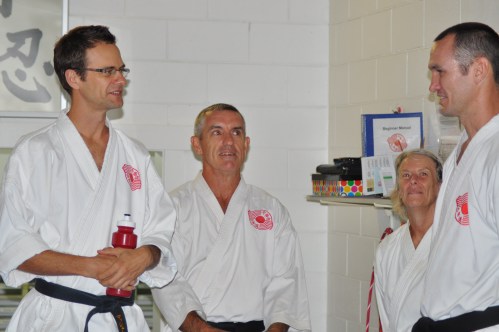
Pictured: Matt Stevenson, Jim Morehead, Deb Woodhouse and Sensei Martin Phillips discussing the Kumamoto earthquake.

Sensei Martin Phillips said it is personally very devastating as he had visited and trained in Kumamoto many times in last 20 years.

“I have friends that have been left homeless, at least in the short term, fortunately all are safe and none were not injured in the disaster,” he said.

“While I have experienced many tremors while living in that region of Japan, you never expect a major earthquake to happen,” he said.

“It is unfortunate for the Australian competitors who were in the process of making final preparations for the tournament, and who have trained so hard for the last 18 months,” he said.

“Local competitors have not just lost an opportunity to represent their country this year, there are also associated financial costs for Karate families,” he said.

“Most competitors quickly got over their initial disappointment, with their hearts going out to those impacted in Japan,” he said.

Unfortunately some Australian representatives will miss out on this once in a life time opportunity, as a result of an expected minimum 12 month postponement of the tournament.

“ While there is some disappointment, most competitors are still training hard and have readjusting their goals and many feel that it is a great opportunity for them to improve and be more competitive next year,” he said.

He believes it will bring the International Chito-ryu community even closer together and stronger for the future.
DSC_0280

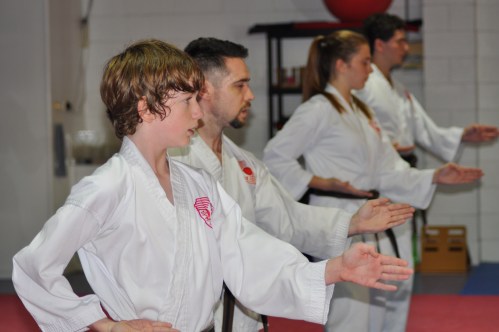
Pictured: Australia Chito-ryu Karate representatives (Bailey Keefe, Sam Hurt, Renee Saunders and Jack Graeme) back at training for the postponed World championships to be held in Kumamoto, Japan, in 2017.

Deb Woodhouse, (featuring in the video below), who was chosen to represent Australia in the over 60 women’s division, said the earthquake changes nothing with regard to her personal goals to represent her country.

“I feel devastated for the people of Kumamoto and the Chito-ryu family in general, particularly, that the Headquarters (Sohonbu) is damaged and may never to be repaired,” she said.

“That’s the home of our style of karate, all that history, and I may never get to see it, now.” she said.

“While tragic, I also feel it is test, it won’t stop Chito-ryu Karate, if anything, it has inspired me to train even harder,” she said

“The club will do some fundraising to rebuild the Sohonbu [Headquarters], but just the fact that we continue to do Chito-ryu is a great support for our Karate family in Japan,” she said.

Deb Woodhouse’s story is featured in the following video as she prepares to compete at the Chito-ryu Karate World championships that was to be held in Kumamoto, Japan in August 2016.

https://www.youtube.com/watch?v=C8YGnVQnIB4

Highlights from the previous Chito-ryu Karate world champions (Soke Cup) in Hong Kong in 2013.

https://www.youtube.com/watch?v=IaibddyeUIQ

Gratefulness

Ware ware  Chito ryu karate-do o shugyo suru mono wa

Tsuneni bushido seishin o wasurezu

Wa to nin o motte nashi

Soshite tsutomereba kanarazu tassu

We who study Chito-ryu karate-do

Must never forget the spirit of the samurai

With peace, perseverance and hard work

We are sure to reach our goals

At the core of the Chito-Ryu philosophy is the ‘Showa’, a poem recited at the end of every classes by teacher and students. Originally written in Japanese, it is difficult to accurately translate to English as many  Japanese words do not have a direct translation.  To understand the concepts of the Showa is essential to the study of Chito-Ryu Karate.  As simple as the ‘Showa’ appears, it is a life long study, considered and applied to every aspect of life.

Wa Nin
The original meaning of “Wa” is to respond to the hearts of others by softening one’s own heart and bringing it in line with the feelings of others. Softening is this case means to become peaceful or in other words to become harmonious. Furthermore, the two energies of Yin and Yang are naturally adjusted and one can develop friendly relationships with others which smoothly prepares the way for harmony.”Wa” is seeking a peaceful heart.

The Chinese character “Nin” is composed of the two Chinese characters, “sword” and “heart”, which means to grasp the meaning of perseverance with one’s heart. Nintai also contains the strict aspects of patient endurance, forgiveness and to admit or to allow.”Nin no ichiji ni tsukiru no mon.” The most important thing in order to carry out life’s many tasks is to engrave this one word, “Wa Nin”, in one’s heart. As Rohonchu stated, “

“Wa Nin is a strong spirit with a heart of forgiveness and patient endurance that is necessary in order to find a heart of peace”.

“Most people these days are geared to judge by evidence of the end product. Conduct- the way we reach that end-is not always given consideration. Yet within the context of Japanese Budo, by elevating the status and importance of conduct, or Saho, we gain a different, potentially useful perspective.The ends are largely secondary to the means, or the conduct by which we meet those ends. This was particularly important in a culture like old Japan’s, where the weight of philosophical and religious thought was balanced towards the notion that winning, losing, profit or poverty were matters determined by fate. Mankind had little control over the vicissitudes of life. What he could control in the face of prosperity or adversity, was his saho, his conduct in the face of what fate offered.”

“… Personal behaviour and the constant maintenance of a strong spirit are considered more relevant attributes than the more measurable qualities of success and failure…”

(The Essence of Budo. Dave Lowry Chapter 11, Budo Saho)

“The  “three poisons” of Buddhism- greed, anger, and foolishness- are well categorised. When evil things occur in the world, if we examine them against these three categories, we will find that there are none that do not fit into one of the three. And if we examine the nature of fortunate situations, we will find that that there are none that cannot be attributed to either wisdom, benevolence, or courage.”

“There is nothing outside the present moment. Life is nothing but a series of moments following one after another. If one becomes aware of that fact, there is no reason to be in a hurry and no reason for searching for anything else. All one has to do is hold onto the present moment and get on with life. Yet every one lets the moment slip from their grasp, believing that there is something else over and above the present moment and hunting all around for it, losing their awareness of the here and now. It takes a lot of practice to learn continually to be in the present moment and not let it slip.

However, once one has found this realm, even if he can not remain in it constantly, it is already the real thing. If one has truly understood that everything is in this moment, then’s one life will become far less complicated. The loyal heart is completely present in this moment.

FINI

http://www.huffingtonpost.com/2015/01/06/forgiveness-how-to-truly-forgive_n_6397176.html?ncid=fcbklnkushpmg00000023

There is a saying, ‘As the water rises the boat also rises”. When a person of talent or a person proficient in a certain art encounters a difficulty, his heart rises to meet the challenge, and the greater the challenge the more he is spurred to take it on. This is different from a person who thinks of the difficulty as just a lot of trouble.

” Master Tannen used to teach us, “If a monk does not put his compassion on the outside and store up the courage within, he will not be able to achieve. the Buddhiist Way.” If a Bushi does not put his courage on the outside and possess a heart of great compassion within, that is enough to burst his belly, he will not be able to discharge his fundamental duties as a bushi. Accordingly, a monk must seek courage from the example of the bushi, and the bushi must seek compassion after the example of the monk.

RONIN Protection Services

Personal Protection/Security/Private Investigation

Bigg Elephant

Tales of a Karate Journeyman